
Tone Galaxie Chengdu International Youth Chamber Music Week
February 1–8, 2026
Tone Galaxie
Chengdu International Youth Chamber Music Week
February 1–8, 2026 · Full Recap
Eight days. Fourteen young musicians. Two countries' faculty. One question at the centre of it all: what changes when you stop playing alone?
The first Tone Galaxie & Xiangyue International Youth Chamber Music Week ran from February 1 to February 8, 2026, in Chengdu. It brought together piano students from Teacher Yang Yang's studio alongside string and wind players affiliated with Xiangyue, with joint coaching from Chinese and Korean faculty — a collaboration that had been in discussion for more than a year, finally realized.
This is the day-by-day record.
Day 1 — February 1: Arrival and First Ensemble
Students arrived through the afternoon. The opening session was deliberately informal: a shared meal, introductions, and an uncoached read-through of whatever repertoire people had brought. The goal was not to produce anything polished — it was to establish the basic fact of being in a room together, playing together, without the pressure of an audience or an agenda.
Korean faculty member Professor Lee and Teacher Yang Yang sat at the edges of the room and listened without intervening. "We wanted to hear what they already knew how to do," Teacher Yang Yang said afterward. "And what they had never had to do before."
Day 2 — February 2: Technical Foundation
The morning session addressed the foundational asymmetry in most young chamber players' experience: they have been trained to lead, and they do not yet know how to listen while playing.
Professor Lee ran a series of exercises drawn from Korean conservatory ensemble training — listening games, call-and-response patterns, slow-practice protocols designed to force awareness of the other voices in the texture. Students worked in rotating pairs and trios, not yet on their assigned repertoire.
The afternoon introduced the week's core repertoire: Schumann's Piano Quartet in E-flat major, Op. 47; a Beethoven violin sonata; and a Piazzolla tango suite for mixed quartet.
Day 3 — February 3: First Coachings
Ensemble coachings began in earnest. Each group worked for 90 minutes in the morning and 60 minutes in the afternoon, with both faculty present and commenting in alternation.
A recurring theme emerged immediately: young pianists, even accomplished ones, tend to compress the dynamic range of the ensemble toward the piano's natural mid-register comfort zone. String players, trained to project over orchestra, overcompensate. The coachings spent significant time simply on listening from the outside — playing a passage, then stepping back while another student played the same passage on a phone recording, hearing the balance from a listener's position.
"The first time a student hears their own ensemble playing from outside," Professor Lee observed, "they understand something that cannot be taught any other way."
Day 4 — February 4: Cultural Exchange Day
The midpoint of the week was structured as a day of exchange rather than intensive coaching. Korean students demonstrated repertoire from the Korean contemporary art music tradition; Chinese students responded with selected Chinese piano works and arrangements of folk material. Teacher Yang Yang led a short lecture-discussion on how national musical cultures enter the concert hall — what gets preserved, what gets transformed, what gets lost.
In the evening, the full group attended a concert at Chengdu City Concert Hall — a professional chamber programme entirely separate from the summer camp — and debriefed afterward over supper, discussing what they had heard with new ears.
Day 5 — February 5: Deep Repertoire Work
With cultural exchange behind them and three days remaining, the coachings shifted to intensive repertoire depth. Each ensemble group was given a specific interpretive challenge: the Schumann group worked on phrasing the slow movement as a single arching breath across 64 bars; the Beethoven duo worked on the relationship between the piano's and violin's melodic lines in the first-movement development; the Piazzolla group — the most stylistically unfamiliar territory for all players — worked on rhythmic elasticity and the physical gestures of tango.
Faculty feedback became increasingly specific. Recordings were reviewed. Individual technical issues were isolated and addressed.
Day 6 — February 6: Open Rehearsal
Parents and a small number of invited guests attended an open rehearsal session — not a performance, but a working session with full faculty commentary conducted publicly. Groups played sections, stopped, received feedback, and played again.
For many parents, it was the first time they had seen a coaching rather than a recital. Several described it as unexpectedly moving. "You see how much more is happening than you knew," one parent said. "You thought your child was learning pieces. They are learning how to be in a conversation."
Day 7 — February 7: Final Preparations
A full day of preparation for the closing concert. Faculty stepped back; students led their own rehearsals, making decisions about tempo, balance, and staging without direct guidance. Faculty were available for consultation but did not intervene unless asked.
This was intentional. "The final rehearsal belongs to the students," Teacher Yang Yang said. "By Day 7, if we've done our job, they know more about these pieces than they think they do. Our job is to get out of the way and let them trust that."
Day 8 — February 8: Closing Concert and Ceremony
The closing concert was held in the evening. Three ensembles performed their week's work for an audience of families, friends, and invited guests.
Programme:
- Schumann — Piano Quartet in E-flat major, Op. 47 — II. Scherzo & III. Andante cantabile
- Beethoven — Violin Sonata No. 5 in F major ("Spring"), Op. 24 — I. Allegro
- Piazzolla — Grand Tango (arr. for mixed quartet)
- Schumann — Piano Quartet, Op. 47 — IV. Finale: Vivace
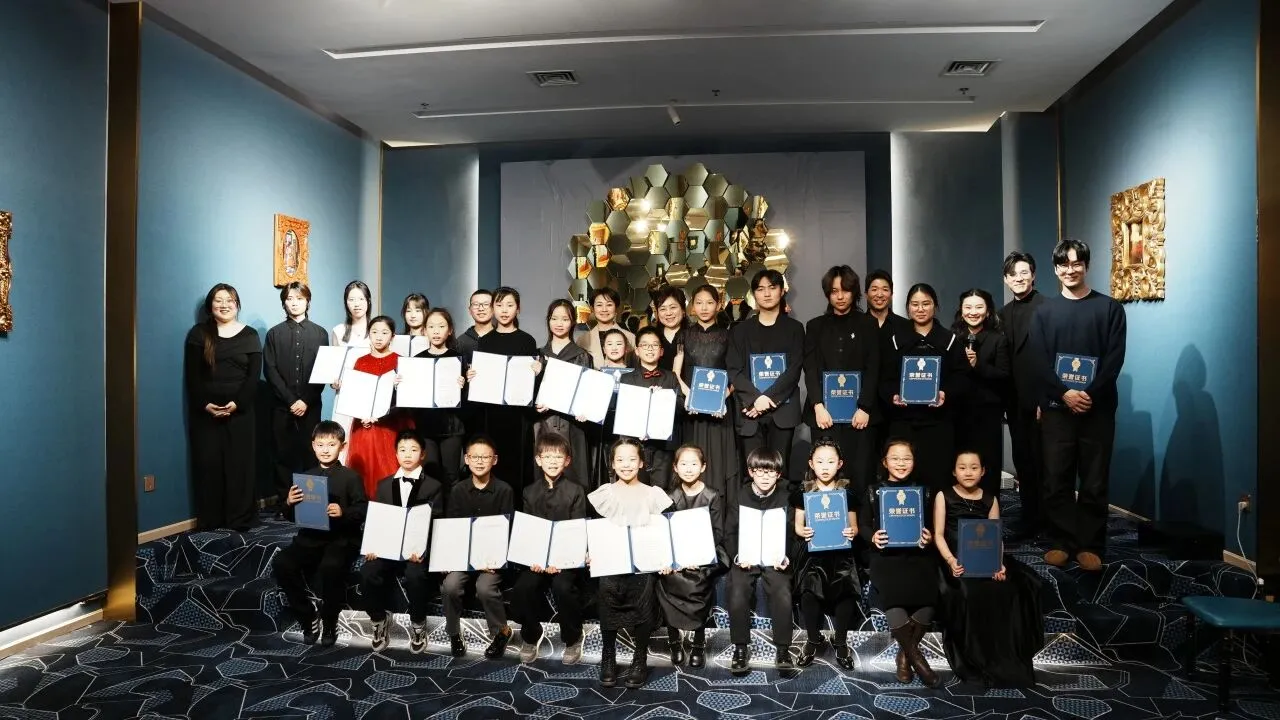
Following the concert, certificates of completion were presented to all fourteen participants. Faculty from both countries spoke briefly — about the week, about chamber music, and about what it means to learn music across cultural and linguistic borders.
Professor Lee, speaking in Korean with Teacher Yang Yang translating, said: "What you played tonight, you could not have played eight days ago. Not because you learned the notes — you had the notes. Because you learned to hear each other. That is the hardest thing in music. You have made a beginning."
What Comes Next
Based on the success of the first session, Tone Galaxie and Xiangyue are planning to make the International Youth Chamber Music Week an annual programme. The next session is tentatively scheduled for late January or early February 2027.
Applications for returning and new participants will open in autumn 2026.