
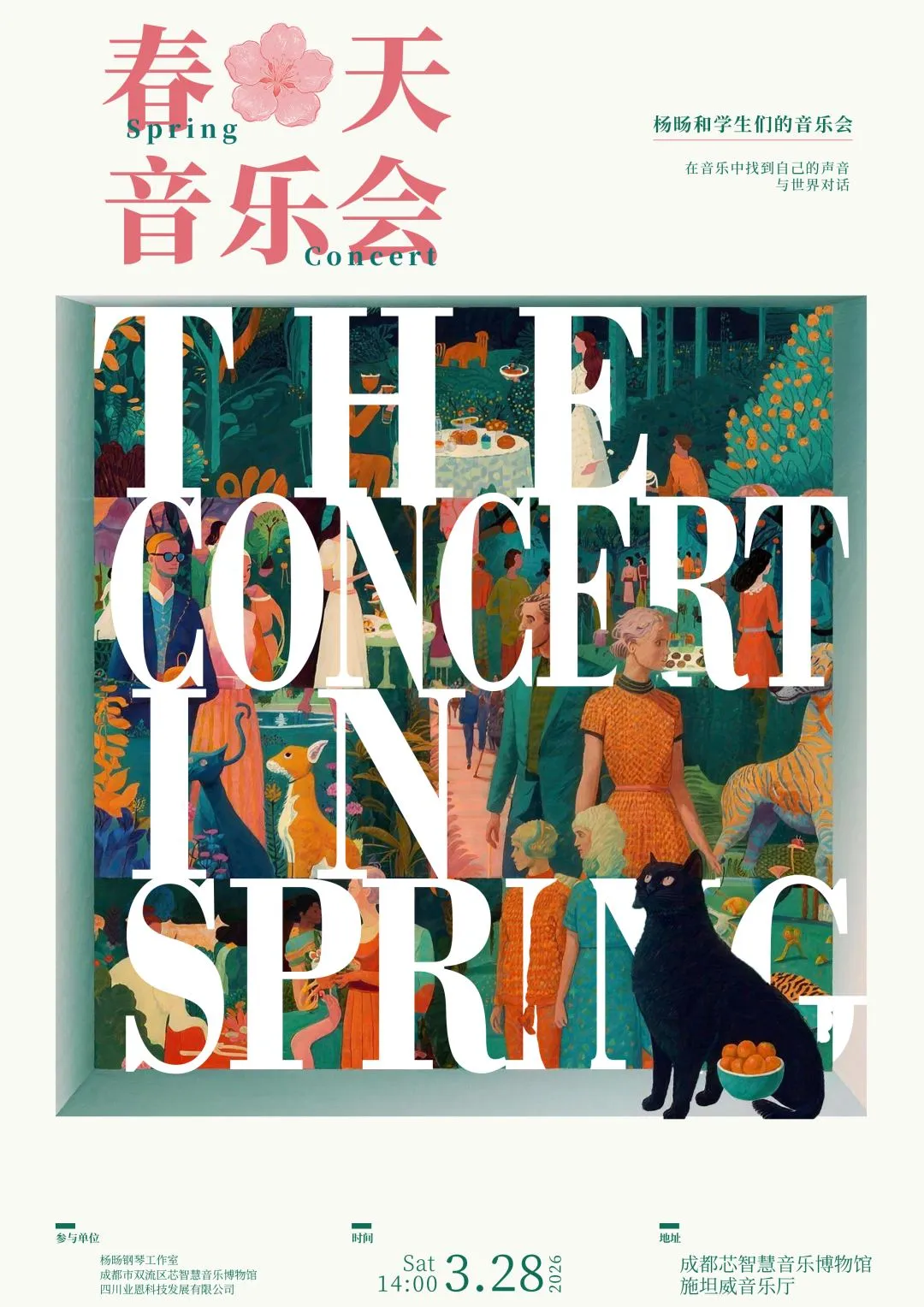
Spring Concert — Yang Yang and Her Students
Spring 2026
Spring Concert
Yang Yang and Her Students
When spring arrives, the studio holds its breath and listens.
Every year, Teacher Yang Yang opens the stage not only to pieces and technique, but to a deeper question: what are we really building when we teach music?
This year's Spring Concert opened with a short lecture before the student performances. Teacher Yang Yang spoke about the moment we are living through — an era of accelerating artificial intelligence, of information overload, of structures that feel less and less solid. "The world is uncertain," she said. "Our job is to grow certain people inside it."
She introduced a three-layer model she returns to often: skill, structure, and character.
Skill is visible and measurable — scales, voicing, pedaling, memorization. Structure is the invisible architecture a student builds inside themselves through years of listening and analysis — understanding why a piece moves the way it does, how tension is created and released, what a composer is actually arguing. Character is the hardest and the last to name: the capacity to sit with difficulty, to fail in front of an audience and try again, to practice something you already do reasonably well because you know it can be truer.
"AI can learn your pieces," she told the families in the room. "It cannot learn your reasons. The child who understands why the Moonlight Sonata opens with that three-note motif, and feels it — that child is becoming someone AI cannot imitate."
Student Performances
The afternoon's programme drew from the full range of levels represented in the studio, from young beginners performing their first complete works to advanced students offering substantial recital pieces.
Selected Programme
- Chopin — Nocturne in E-flat major, Op. 9, No. 2
- Beethoven — Piano Sonata No. 14 in C-sharp minor ("Moonlight"), Op. 27, No. 2 — I. Adagio sostenuto
- Tchaikovsky — The Seasons, Op. 37b — "June: Barcarolle"
- Chopin — Ballade No. 1 in G minor, Op. 23
- Beethoven — Piano Sonata No. 8 in C minor ("Pathétique"), Op. 13 — II. Adagio cantabile
- Tchaikovsky — Piano Concerto No. 1 in B-flat minor, Op. 23 — I. opening cadenza (solo excerpt)
- Chopin — Étude in C minor ("Revolutionary"), Op. 10, No. 12
- Original composition — performed by a senior student
Full programme and running order distributed at the door.
Each performance was followed by a short spoken reflection — some by the students themselves, some by parents or Teacher Yang Yang — on what this piece meant, what it cost to learn, what changed in the student while they were working on it.
One mother described watching her son practice the Pathétique slow movement for four months: "He was frustrated for the first two months. I asked Teacher Yang Yang whether he should move on. She said: 'Not yet. He is learning to be patient with beauty. That is the lesson.'"
A senior student, performing Chopin's First Ballade, spoke before she played: "I have been working on this piece for a year and four months. I still don't feel I've found the ending. But I think that's also the point — it ends without resolution because some things in life don't resolve. I am learning to be okay with that."
After the Concert
Families were invited to stay for tea and informal conversation. Teacher Yang Yang was available to discuss each student's next steps — repertoire, exam preparation, upcoming competitions, and in several cases, decisions about whether to continue at a serious level or to rebalance music alongside other academic demands.
"Every family has to make this decision for themselves," she said. "My job is to make sure they make it with clear eyes — knowing what serious music training actually gives a child, and what it costs, so they can choose honestly."